How to Measure Ring Size at Home
Three reliable at-home methods — string or paper, an existing ring, and our on-screen sizer — plus the timing and fit tips jewellers actually use.
Last updated: November 2026
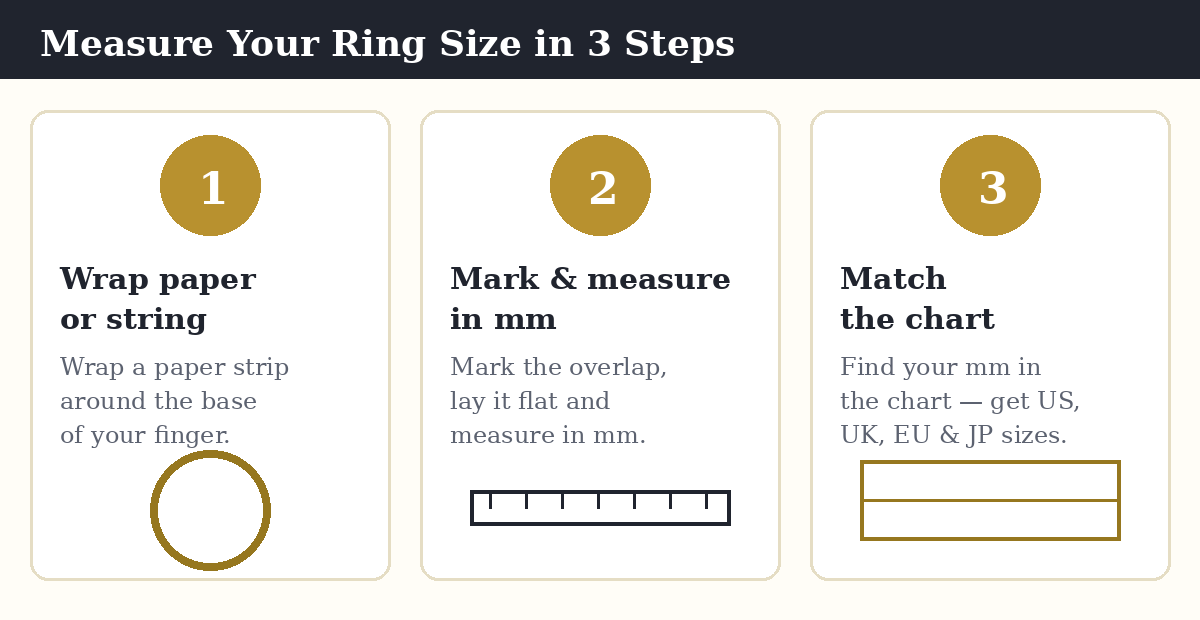
Method 1 — String or paper (for a bare finger)
- Cut a thin strip of paper about 5 mm wide, or use non-stretchy string. Paper is better — string and thread stretch and read small.
- Wrap it around the base of the finger, snug like a ring — touching all round, not digging in — and over the knuckle if your knuckle is wider.
- Mark the overlap with a fine pen, unwrap, lay flat and measure the length in millimetres. That is your circumference: enter it in the calculator.
Method 2 — A ring that already fits (most accurate)
- Pick a ring worn on the same finger of the same hand — the other hand can differ by half a size.
- Measure straight across the inside at the widest point, in millimetres. Measure the opening, not the metal.
- Match it: 16.5 mm = US 6, 17.3 mm = US 7, 19.8 mm = US 10 — or place it on our on-screen sizer. Full table: ring size in mm.
Fit tips that prevent returns
- Measure at the end of the day, when fingers are warm and largest — and repeat on 2–3 days.
- Knuckles rule: the ring must pass the knuckle; size for the knuckle, not just the base.
- Wide bands (6 mm+) need about half a size more than a narrow band on the same finger.
- Between sizes? Go up. Slightly loose beats stuck.
Sizing someone else? Read how to measure ring size secretly. Buying an engagement ring? See the engagement ring size guide. No ruler handy? Print the printable ring sizer.
Wide bands fit tighter — size up
A wide band covers more skin and grips the finger over a longer stretch, so it feels tighter than a slim band of the exact same size — the most common reason men’s wedding bands (often 6–8 mm wide) come back for exchange. Stacked rings compound it: two or three slim bands worn together behave like one wide band, so allow the same half size when you plan to stack. A comfort-fit profile, domed on the inside, slides on more easily and eases the effect slightly, but it does not cancel it. Practical approach: measure with a sizing ring or strip of similar width to the band you are buying; if you are between sizes on a wide band, always take the larger one.